Friday, July 03, 2009

Party Crasher!

Awww, Louisville hasn't forgotten me.

Velocity Weekly, one of the city's entertainment papers, has just published an article about me, the Metroschifter and Sweden.

Written by the talented and funny Joseph Lord, the story starts with the line, "Scott Ritcher is experienced at getting the hell out of town..." I love it. As I just told my friend Sarah who is soon leaving Louisville for Philadelphia, our home city is always a fun place to be and a wonderful place to come back to.

Joe even gives a shout-out to my advocacy for light rail mass transit in my 1998 candidacy for mayor of Louisville. (God dammit! Why do I keep saying "shout-out"?) What a shame that eleven years later light rail is "...still ahead of its time today."

The article appeared on their Metromix website a couple weeks ago and came out in its paper version last week.

Velocity may be running out of "Scott" puns. A few years ago when I was on the cover, the headline was "Great Scott!" and this one is called "Scott Free." If I make another appearance in the future, maybe it'll be "Beam me up, Scotty" or something about "Scott-land."

You can read the piece online at Metromix.com or see this scan of the paper version in Velocity that my sister emailed to me.

The paper version has an extra photo of me taken by Iida at a spring afternoon dagens party in Vitabergsparken. Dagens, being the popular drink made of white wine, Sprite and frozen strawberries.

Wednesday, July 01, 2009

Space Invaders at Thorildsplan

As we've learned in several previous stories, Stockholm's Tunnelbana (subway) system is often called "the world's longest art exhibition." Each station has been decorated by a different artist or several artists, and some stations were even designed as walk-through art by architects. This underground art project began in the 1950's and continues today.

The latest station to receive an artistic makeover is the Green Line platform at Thorildsplan. The station opened in 1952 and was previously decorated. However, in the fall of 2008, the existing art at the station sadly had to be removed because it had been so badly damaged by repeated vandalism.

To replace it and refresh the station, 43-year-old Swedish animator and painter Lars Arrhenius was selected.

Inspired by popular, vintage video games and computers, Arrhenius used the context of the easy-to-clean grid of tiles that traditionally blanket subway stations as an enlarged canvas of gigantic pixels.

I have a feeling that many of my friends who see this will go nuts for what he did with the station. I was certainly dazzled, tickled, amazed and blown away by it. It's truly jaw-dropping and seemingly unimaginable by American standards of publicly-sanctioned art.

As always, you can click on any image to see it much larger.


A plaque at each station speaks of the art and artists. This one is near the entrance and greets you as you're walking in from the street.

It says the artist wanted to make the station, like a large computer game, specifically the early arcade games of the 1970's and 1980's. Like in these old games, the moving trains are like traffic around the carousel and are constructed of different entrances and exits, bridges, tunnels and elevators.

He has been inspired by different kinds of pixels, symbols and data icons from these types of games. With all these symbols, he created his own game with the same objectives as the sources that inspired him: enjoy the journey and capture a ghost and UFO along the way.


If you're arriving from another station and getting off the train at Thorildsplan, the wall surrounding the ramp and stairs that descends to street level is your introduction to the artwork. A long scene that wraps around this short wall is inspired by Space Invaders...


...and Pac Man wraps around the stairs.


As artist Lars Arrhenius said in his statement, just like a subway station, old video games are filled with elevators, ramps, stairs and moving vehicles. It's quite exciting how he has brought the two together.

As you walk around the short wall to get approach the stairs, a bridge to the elevator is sandwiched with a ghost from Pac Man and a mushroom, which I'd like to think is from Centipede but is probably more of the Super Mario Bros. variety. Swedes know more about mushrooms than I do.


Pointing the way down the stairs is an early Microsoft Windows-style arrow.


On the wall opposite the Windows arrow is the bomb that would appear when your vintage Macintosh produced a system error. It's true, kids, old Macs used to completely crash. However nostalgic I may be, I don't miss seeing that old guy in the middle of my work, but it did get me in the habit of hitting Command-S to save all the time.


To the right of the Mac bomb are rain clouds and more mushrooms from Super Mario on Nintendo.


Clouds connect between the opposing walls, revealing a Super Mario smoke stack. A ladder next to them could be from any game, I'll pick Donkey Kong.


More Space Invaders on the outside of the stairs.


Cherries from Pac Man


A long ramp cuts through the middle of the platform and this side is covered in tunnels reminiscent of Dig Dug.


Opposite from Dig Dug is an old Macintosh trash can, last seen in System 6, complete with Oscar the Grouch inside. I don't know if it was an Easter egg put into the system by Apple programmers or if it was a thrid-party add-on, but I remember some very old Macs used to have Oscar in the trash can. He would sing a line of "I Love Trash" when you emptied it.


Here we see more Windows-inspired icons, the unforgettable hourglass and the magnifying glass.


E-mail? That seems kind of futuristic, but Blinky seems to love it. (FYI: I didn't really know what the red ghost from Pac Man was called. I had to Google it.)


A bridge from underneath showing more of the marriage between video game aesthetics and subway architecture.


One interesting characteristic of the all-over art at this station is that it even wraps around the outside of the structure. This photo and the one below are parts of the station you would only see if you jumped onto the tracks or lived on an upper floor of the apartment house across the street. You can catch a glimpse of this for just a second if you're inside the train when it is passing through. I wanted to see it, but I didn't think it was worth an arm, so I waited until just after the train left to hold my camera out around a barricade to get these shots.


What I really love about the art at Thorildsplan is that we usually think of video games and computer systems as disposable. The iconography and graphics employed here have undoubtedly become a part of our everyday lives, but any game or operating system really only lasts a few years in general use.

Some of these classic icons from wildly popular video games bring back the same kinds of memories for us that songs and movies do, but only if you're old enough to recognize them and young enough to remember how they affected you.

By embedding this imagery into a permanent structure, it becomes official. The bomb from the old Macintosh operating system or the ghost from Pac Man are not just memories or blips on screens anymore. They are a part of history.

The art at this station may be "cool" or "campy" right now, but when visitors pass through here in forty years, they will look at the displays in a much different way than we do. It may not tickle or thrill them the way it does for me. They may simply see it the way we see a tribute to old black and white movies. That's just the way things were.


Note: Though it is too old to include the new art at Thorildsplan, there is a downloadable PDF booklet in English about art in the Tunnelbana system at this link on the Stockholms Lokaltrafik website.

My previous Tunnelbana station art visits are here: Solna Centrum, Bandhagen, Medborgarplatsen, Midsommarkransen, T-Centralen Blue Line, Bagarmossen and Transit Museum.

Tuesday, June 30, 2009

Personalized Metroschifter CDs: behind the scenes

For about 90 days between January and April of this year, my band, The Metroschifter, was accepting online reservations for our upcoming new CD.

If you went to our website during that time, you could order the disc in advance of its release, and have the finished version personalized with your name on the cover and mailed to your house.

We made this same type of offer with several of our previous records and decided to reprise the tradition for our latest release. Our first album fifteen years ago was offered in a personalized version, as was a 2-song 45 RPM record we put out in 1997. I was very proud of that single, The Truth Is Always The Right Answer, and not just because it was pressed in Nashville on machinery that once made Elvis Presley singles.

Mailing a bunch of compact discs in jewel cases and puffy envelopes is not only expensive but a huge waste of packaging and energy. So for those people who pre-ordered the personalized version of our new CD, Carbonistas, the way it is delivered is not only very unique and collectable, it is also earth-friendly.

In addition to having the person's name screen-printed on a sticker that seals the package, the CD cover itself is the package it is mailed in. That means that when you have the disc in your CD collection next year or in five years, it will still have your unique mailing address, stamps and dated postage marks on the back cover.

As a special surprise treat, Brandon Skipworth of Noise Pollution (the label that is putting it out) and I thought it would be really cool if the discs were mailed from Sweden. That way, the discs would have Swedish stamps and postage marks, which are decidedly more beautiful than their American counterparts. It costs us much more to do this, but we're not exactly the kind of band and label who are in it for the money. In order to do it, of course, all the discs and personalized seals would have to be shipped to me in Sweden, then assembled, addressed and mailed out from here.

Another key component of the pre-order offer, aside from being delivered to your house with your name on the cover, is that it arrives several weeks before the CD is released in stores. Noise Pollution's distributor had set our release date for June 30th. If the box of CDs and personalized seals arrived in Stockholm in early June, that would give me plenty of time to put them all together and mail them out.

In late May, Brandon shipped the box of Metroschifter CDs from Louisville to my address in Sweden. Also inside this box was the complete set of one-of-a-kind personalized stickers with the names of everyone who had ordered the discs. These were custom-printed and cut in Louisville.

After a couple weeks, when the box did not arrive at my door as expected, we started to get a bit worried. By the time we tracked it down, it was already on its way back to America. Apparently, the Swedish post office has no idea where the building I live is located and they couldn't use Google Maps to look up the address on the package. Fan också!

This left us a few options, none of which we liked. We could reprint the entire set of personalized tags and ship them with another box of discs to Sweden, then quickly try to get them all delivered before June 30th. We could wait for the first box to be returned to Louisville, and assemble and post-mark the discs from there. That would mean somebody else would end up doing all this pain-in-the-ass work that I created only because I thought it would be me doing it. I really didn't want to shove that off on anyone.

Either way, there were no guarantees. The last thing we wanted was for someone who ordered the CD to see it in a store before they saw it in their mailbox. We eventually decided we had to ask the distributor to push back the release date. This would give us the extra time to make sure we did everything right.

The distributor was kind enough to change our release date to July 28th and the original box showed up in Louisville again, surprisingly sooner than expected. Within about ten days in had been turned around and actually found me this time in Stockholm.

Answering the door and seeing the box was incredibly exciting. It had US Postal Service tape all over it and it looked so American! My enthusiasm dropped quickly when the deliveryperson told me there were customs taxes due on the shipment. At first I thought she said "1 krona" (about 13 cents). As I started to reach in my pocket, I saw that the form she was holding had the amount printed on it: 1001 kronor! Holy shit! That's like 130 US dollars!

Sadly, I didn't have a thousand kronor laying around the house, so she had to give me a receipt to pick up the box at the nearby postal center. Mind you, this entire conversation was being performed in my sub-preschool-level Swedish. Difficult for me, but I'm sure it must have been excruciatingly painful for the party who was not me.

I knew exactly where the postal center was from when I walked there with Iida in May to pick up her new driver's license. It's about a 20-minute walk from the apartment, but it was a beautiful day and I was thrilled to get the package. Along the way, I stopped at a cash machine and took out the thousand kronor I needed to collect the box. (Ouch.)

When I arrived at the postal center, an older woman was helping me and it quickly became clear that this conversation was also going to be conducted in Swedish. My apologies to the Swedish people who speak with me.

Curiously, two different people asked me for directions when I was in the city today and I managed to send them off the proper way. People almost never talk to me and today it happened three times. Maybe it's because I just got a haircut and I was wearing a nice, white shirt. I even had earphones on all three times people started talking to me. I thought that was the international signal for "leave me alone." If they only could have heard what I was listening to: "Fresh... Färsk. When... När. Therefore... Därför. Already... Redan."

This postal place is like a dispatch center for business mail. It's a rare animal because, believe it or not, Sweden doesn't have real stand-alone post offices. All the traditional-style, regular post offices were shut down by 2001. Now, instead, there are postal service points which are operated out of newsstands, groceries and convenience stores. It's like, inside the corner of the grocery store there's a little booth where you can mail things and pick up parcels that are too large to be delivered to your home. Most of the mail carriers in the city travel on bicycles, so pretty much anything larger than a book is "too large to be delivered."

In any event, when I presented my delivery stub to the lady behind the desk, she scanned it and told me the package might not be there. Great. An all-new nightmare scenario began playing out in my head. The world wasn't on fire just yet when she popped back out from the other room, producing the fabled box. Äntligen!

On my way back to the apartment, a few things crossed my mind:

I am in Sweden, carrying a box of CDs by my band from Kentucky.

The first time I ever came to Sweden, I was on tour with that band. The first time I met my roommate, Iida, was when our bands were playing a show together.

Jesus, that was ten years ago. My band has been making records for fifteen years.

Music brought me to Sweden and now here I am carrying a box of my music to my home in Sweden.

This is weird, I'm sweating. I think it's summer now. It's kind of hot out here. I think it might rain. Is it starting to rain?

Wow, I'm almost 40. What am I doing playing in a band? What am I doing here?

Oh shit, I haven't even seen the cover yet. I mean, I designed it, but I haven't actually seen it. Maybe I should open the box here on the sidewalk and take a peek. No, probably not. I think it's going to rain. I'd hate for the CDs to come this far and then get ruined in the rain because I can't wait ten minutes to look/


I got back to the apartment with only a few drops of rain having fallen and I tore into the box. After the early reveling in inspecting the new materials, I began assembling the CDs almost immediately. Everything looked as expected and I played the disc while I worked to make sure it sounded right.

Here are some highlights from the assembly process, which took a couple days:


The compact disc and cover sleeve


A stack of the personalized stickers. These were printed in Louisville by Matt "The Matador" Odenweller of Monkey Drive Screenprinting, who went on tour with us in Europe last year.


One of the first personalized and sealed discs


A stack of discs, personalized and sealed


Matching personalized discs with their address tags


Addressing a disc


A disc with the address sticker on it. This one is going to our old friend Ulf in Germany who named one of the songs for us!


Sealed, addressed, stamped and ready to go. Well, some of them will get more stamps and air-mail stickers. I should be finished mailing all of them out within a week.


This is me holding one of the discs up to the buildings the appear on the cover in Stockholm's Mariaberget neighborhood on Södermalm.

Monday, June 29, 2009

Uniquely American

Today, I'd like to talk about two huge financial systems in the United States and how they could maybe benefit from - once again - a little Swedish influence. No, this isn't about Wall Street or the economic crisis, but perhaps they share some of the same types of thinking, or lack of thinking, that have contributed to those problems.

Ever since I was a kid, I have been baffled by the concept of check writing. Essentially, when you write a check, you're saying to someone, "I have the money I owe you, but it's not with me right now. I'll write you this note that says how much money I'm giving you and if you take it to my bank they'll give you the money."

This primitive system is totally based on trust. If the person writing you a check has made a mistake in their checkbook or if they are simply lying to you about the document's validity, you may not ever get paid.

A bad check will cost you money in fees from your bank and will likely cause you to unknowingly issue a few bad checks of your own. Maybe the person writing a check to you has received a bad check and will be surprised that they never paid you.

One bad check can start a chain reaction through the accounts of any number of people, bringing headaches for people who don't deserve them and a money train of fees collected by their banks.
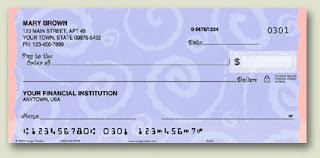
When everything goes right - if someone writes you a check that actually is good - it can take as long as a week before you are able to spend the money. That's because when you deposit a check into your account, your bank has to then send it to the issuer's bank to actually collect the money for you before the funds are available to spend. This delay of typically 3 to 5 days is a hassle as well.

There's a reason "the check is in the mail" is a funny line. It takes forever to move money this way. Convenient, because usually the person saying it hasn't mailed it yet.

This isn't the first time I've written of the absurdity of this system and the ways American banks exploit it to collection hundreds of millions of dollars each year by generating a laundry list of stealth fees on their customers' accounts.

One of the most popular things I've written over the years was an article titled In Banker's Clothing. By "popular" I mean that I hear about it from people more than most other things I've written. Maybe it's not so much popular as it is something that invites them to share their feelings of mutual disgust and infuriation. Like health care, every American has a banking horror story.

In 2001, I bounced a check when registering my car in Louisville. This was right before I moved to Rhode Island. The news of a bounced check is communicated by mail, which takes a long time, especially when there is an out-of-state change-of-address involved. I really can't express what a series of pains in the ass the chain reaction of this bounced check became.

Even though I repaid the check to the office as soon as I found out about it, unbeknownst to me, the County Clerk's office issues arrest warrants for these infractions. Furthermore, such a warrant is not automatically canceled upon payment.

Years later during a visit to Louisville, I was arrested and spent the night in jail - not for jumping the fence of an apartment building with a bunch of friends to go swimming in the middle of a hot night, but for a bad check that I had repaid years ago and forgotten about.

I'm no fan of banks, suffice it to say. For years, my life has been conducted as much as possible in a cash-only manner. I do have a bank account and debit card, but I have not had a credit card or any loans or real debts in more than ten years.

Funny thing, if you jump out of the system like I did, it's almost impossible to get back in. A few years ago I tried to buy a house in Louisville. I have been a lifelong renter and this was at the time when "everyone can buy a house" in America. Well, not me. I had more than one mortgage specialist tell me, "You don't have a credit score. I've never seen anything like it." In the '90s, I had bad credit, now I have none. Possibly it was a blessing in disguise that I was unable to buy a house when "everyone" could. We all know how that turned out for "everyone."

When I started writing this article today, I had a line in it that described checking as "a preposterous, archaic, 18th Century way to do business." Upon further research, I found I was being way too generous with that burn. In reality, checking dates back to the 3rd Century. Yes, the Third Century. You know, about 1,800 years ago? The fucking Romans came up with it! One empire's innovation is another empire's... I don't know, something.

In the same way that personal checks rely on everyday people to be both honest and skilled in math, so do income taxes. It is truly mind-boggling that individual Americans are responsible for calculating their own taxes each year.

In the United States, the country that is the undisputed world capital of inventing new ways to scam people, expecting everyone to honestly calculate their own share of taxes is simply an insane way to collect funds for public services.

Not too long ago, The Pittsburgh Post-Gazette reported that "an estimated 30 percent to 40 percent of taxpayers cheat on their returns, defrauding the government of some $290 billion a year, according to an Internal Revenue Service analysis of 2001 returns. Some believe the real percentage of tax cheats is much higher."

How much money is $290 billion a year? Quite simply, it is more than almost any previous year's Federal Budget Deficit. (Read that again!)

The Federal Deficit is an annual number that is the difference between what the government collects and what it spends. Each year, this difference is added to the national debt.

Before this year's stimulus-reinvestment-bailout budget, the annual deficit had only tickled $290 billion a few times. The amount of money that individual Americans are defrauding their own government is a main reason why the nation is in debt. It averages out to about $2,000 per taxpayer per year.


Theoretically, if Americans were not cheating on their taxes, the government would never have needed to borrow money from banks or foreign nations, and consequently would not be in debt.

You could, of course, go further and say if the US was not fighting two simultaneously monstrous wars that are draining the coffers, the resulting surplus and ability to provide better services would be even more spectacular. And if you wanted to, you could argue that if Americans weren't already paying one of the lowest tax rates in the industrialized world, and if everyone over a certain income level (including corporations and religious groups) paid taxes at a fair, across-the-board rate... well, I was dreaming when I started this line of thought in the first place.

Only about 1% of tax returns are ever audited. Those are pretty good odds and Americans know it. Joe Antenucci, professor of accounting and finance at Youngstown State University said, "Any gambler will tell you, when you have a high payoff and low risks, that is when you want to be involved."

Just like with check writing, when everything goes right, taxes are also a headache. Each year, Americans labor through confusing tax forms, calculate their taxes, and live in fear of the IRS. A national poll conducted by the Discovery Channel in 2000 showed that 57% of Americans feared the IRS more than God.

Nothing's scarier than getting an envelope in the mail with their logo on it, even if that logo looks like a chicken with big tits.

How does this have anything to do with my ongoing discovery of Swedish culture?

Rightfully so, both check writing and self-calculation of your own taxes seem totally insane to Swedes. As you might have guessed, the back-asswards process of individuals calculating their own taxes and being responsible for the errors is uniquely American. It's almost as insane as trusting someone who writes down an amount of money on a piece of paper, thereby magically transforming that piece of paper into a bank note worth that amount.

In Sweden writing a check to make a purchase or pay a debt is something that happens only at very high levels of corporate trade and finance. Ordinary people never come in contact with checks.

Instead of personal checks, in Sweden (and in essentially every European country), they use a system called giro (or girot, depending on the country, all pronounced JEE-roh). The nearest thing Americans could equate it with is direct deposit. However, the difference between giro and direct deposit is that giro goes in both directions. It is not just for deposits and the system is accessible to individuals, not just large companies.

For example, if you get a bill in the mail for your rent, telephone service, cable TV, school tuition, or anything else, it comes with a tear-off stub that has a unique giro number on it. You take the stub to your bank and give it to the teller. The money is instantly transferred from your account to the requester's account. No waiting. Because of the unique number assigned to each stub, the company instantly knows you have paid them. Of course, this can all be done online as well, and some of these debits happen on regularly scheduled dates, requiring you to do nothing.

Wow, this giro system that processes instant payments from account to account sounds pretty modern, right? It must be on the cutting edge and reliant on fairly new technology. Guess again. Sweden implemented the giro system in 1925. By the 1950's, practically all of Europe was using some variant of it. For decades, it has been the standard way money moves in Europe.

Sveriges Riksbank, which is Sweden's central bank, says that in 2007, "giro transfers accounted for a good 94 percent of the total value of transactions and for 29 percent of the number of transactions" in the country. Most small transactions are completed with debit and credit cards, and by "most" I mean practically all of them. Riksbank says it was 62% of all transactions in 2007. Paper money was barely a blip on the radar (which is a shame since Sweden's currency is downright gorgeous) and checks were basically non-existent.

In fact, several of my Swedish friends have told me they have never seen a check in real life. They know what checks are only from American films and television. You'd think it would be funny, like when you see an 8-track tape in an old movie. To the contrary, even in Sweden, a country intimately familiar with American culture, someone writing a check is one thing that seems truly foreign.

Swedes use debit cards for everything. Even the tiniest, little amounts, like one cup of coffee or a candy bar at a convenience store are paid for with cards. Almost nobody will run a tab at a bar - each individual drink is paid for with an individual debit card purchase each time - and most of these transactions require a PIN code entry at the point of purchase.

A few months ago, while I was in Sweden, someone made a duplicate of my debit card and went on a shopping spree in Florida. Sophisticated thieves are apparently now able to manufacture fake cards with real numbers and use them in stores. Someone's card number can be intercepted virtually anywhere and a new card can be produced from it. This was the second time it has happened to me.

Every Swedish person I talked with about the situation asked the same question, which was not "How did they get your card number?" but rather, "How did they get your PIN code?" Swedes are blown away by the fact that you don't need a PIN code to make a purchase with a card in America, all you need is the card. And if you're making a fake card, you can just put a name on it that matches an ID you have, on the off chance that a merchant asks for your ID.

Checks, giros, debits and taxes all cross paths at this point in our discussion. In Sweden people are paid from their jobs in essentially the same automatic way as they pay their bills. On the 25th day of every month, money appears in their accounts automatically. (Good luck going out to eat or to the state-run liquor store Systembolaget on the Friday after the 25th.)

Money appearing in your bank account is like direct deposit in America, and this happens with the taxes already deducted, but that's where the similarity ends as far as taxes are concerned. For Americans, the amount removed from their paycheck is just one piece of a nerve-wracking puzzle that must be assembled in paperwork at the end of the year.

For the majority of Swedes, everything about tax collection is also automatic. Taxes are taken out of your wages before they are deposited into your bank account. At the end of the year when your tax forms come in the mail, all the numbers are already filled in. That is, when you open the envelope, all the numbers are already on the page. All you have to do is confirm that the numbers are correct, which you can do by telephone, text message, or computer. If everything looks right, that's all you have to do. You're finished. (There's more to it if you're self-employed or a business owner, of course.)

You're not faced with a stack of confusing forms or the burden of fear if you make a mistake.

I should mention something else as well, that Swedish tax forms are comparatively beautiful. They're borderline cute even (this year's forms had a flower and a cartoon kitty cat on the front), colorful, reminiscent of Ikea order forms and easy on the eyes. The tax collection agency, Skatteverket, even has a logo that's not so bad either.

Aside from automatic income taxes and the 25% sales tax, as I discussed a few months ago, there is one tax in Sweden that people are expected to pay voluntarily. That is the television and radio tax. This tax of about $250 a year helps regulate the airwaves and backs the operation of five publicly-funded television networks and more than forty streams of radio programming.

Whereas 40% of Americans are cheating on their income taxes, even though many Swedes hate the TV and radio tax and feel it is unfairly levied, 9 out of every 10 Swedes are sending in these additional payments voluntarily. Only about 10% are not.

Long story short, for every American who has cried "there's got to be a better way" when balancing their checkbook or preparing their income taxes, well, there are better ways. Again, just like health care, these better ways haven't been made available to Americans, probably because there are people somewhere making tons of money off of keeping the systems broken and confusing.

It's only common sense that there should be no delays, doubts or leaps of faith necessary in financial transactions or tax collection.

Both of these complex, antiquated systems invite inaccuracies and unnecessarily allow the processes to become corrupted. Americans can't be relied on to do the right thing if the opportunity to make an extra buck exists.

Further, in a country whose schools are so lacking, I'm not sure who ever thought it would be a good idea to trust the general public with math. We need not mention the complexity or comprehension involved in addition to the calculations required for paper-based banking and tax preparation.

Even though I had the advantage of being able to go to private schools in my youth, I was never in a course that covered balancing a checkbook, preparing tax forms, calculating annual percentage rates, or any of the basic, real-world financial knowledge every last dumb ass is expected to have.

No wonder 57% of Americans are more afraid of the tax man than the wrath of God. A simple mistake can put you in jail, and if you don't understand how it's supposed to be done in the first place, well, that starts you off with a pretty wide margin for error.

I know Obama's got a lot on his plate and neither of these topics will likely ever be addressed, given the larger, pressing issues of the moment, but like those problems, I think these are indicative of a pervasive "if it ain't broke don't fix it" mentality. Such thinking can only ultimately result in nothing ever being improved, until it reaches the point of being unwieldy.

It is possible to fix things that "ain't broke." In fact, it's advisable. If people made something, there's always room for improvement. You can't just keep adding rooms on to the outhouse until there's a ramshackle mansion attached to it.

Thursday, June 25, 2009

Midsommarafton

Last Friday, I celebrated the Swedish holiday of Midsommar with some wonderful friends and met some new and memorable people as well.

Many Swedes have tiny country homes, garden houses, or small vacation houses outside the cities. It is a Swedish national custom to celebrate the midsummer holiday at your country home or the place of friends. Large gatherings are not uncommon. In fact, the streets of Stockholm were all but abandoned during the afternoon. It was like walking around an American city when the Super Bowl is on television, or through Louisville during the two minutes of the Kentucky Derby race.

Our friend Axel's parents were out of town at a country home, so he was kind enough to invite a group of friends over to enjoy their empty house in Stockholm.

While there was no pole to dance around and no girls with wreaths of flowers in their hair, there was an amazing, extensive feast with traditional Midsommar dishes, accented with a round of snaps ("schnapps"), as is the custom of the day. Actually, it seems the custom calls for endless rounds, but even though I did not arrive home until after 6:00 the next morning, our party was not so extreme on the tiny shots of sweet, strong liquor.

Here are some highlights from the day:


The salad


Tiny, fresh potatoes


Some crazy, twin-yolk eggs that Axel's parents purchased from a local farmer who sells them door-to-door. Axel said there was nothing unusual about the man, "He just lives right over there by the nuclear power plant."


After Therese decorated the eggs they looked much less freakish and more like delicious works of art. The black stuff is like a vegetarian imitation of caviar. Soooo salty and tasty.


Erik prepared some vegetable kabobs for the grill which were coated in...


American Barbecue Sauce. This flag appears on pretty much all food that contains high fructose corn syrup. You know, the good shit.


French cheese cubes with very artsy illustrations, from the brand Glad Ko ("Happy Cow").


Dagens, of course, to drink.


Erik at the grill


Axel and Therese


Elin


Me with rabbit ears courtesy of Iida
To comment without registering just choose Anonymous, then include your name in the message if you like.